
- Best for
- Comparing oily, dry and sensitive-skin sunscreen options
- Routine place
- Final morning skincare step, before makeup
- Frequency
- Every morning; follow the reapplication directions below for your chosen formula
- Keep in mind
- Known allergy or repeated irritation: ask a pharmacist or doctor
Which Lava Derm sunscreen suits you? All four are SPF 50+ PA+++, so choose by texture, tint and filters. Oily or combination skin: Lava Derm Acne Fluid SPF 50+ (oil-free, untinted fluid) or Lava Derm Sunblock Cream (oil-free, extra-matte cream). Sensitive skin: Lava Derm Physical Sunblock Fluid (untinted, mineral and organic filters). Dry or sensitive skin and a soft tint: Lava Derm Physical Sunblock Cream (UV filters: titanium dioxide and zinc oxide only).
Key points
- Both fluids list avobenzone and octinoxate; if you avoid either, check the pack of each.
- At least 1 teaspoon (about 5 mL) for the face alone, with more for neck and ears.
- For swimming or sport, look for an explicit water-resistance claim on the pack.
Which Lava Derm sunscreen fits your skin and preferred finish?
SPF describes protection mainly against sunburn-causing UVB. PA+++ is a UVA grade on the pack, separate from SPF. Neither rating describes texture or finish.
Start with texture and finish: preferring a fluid is different from preferring a matte appearance.
For oily or blemish-prone skin, look for “non-comedogenic” or “won’t clog pores” on the pack. These concern pore clogging; oil-free describes a different feature.
| Your skin and preferred finish | Product | Texture, tint and filters |
|---|---|---|
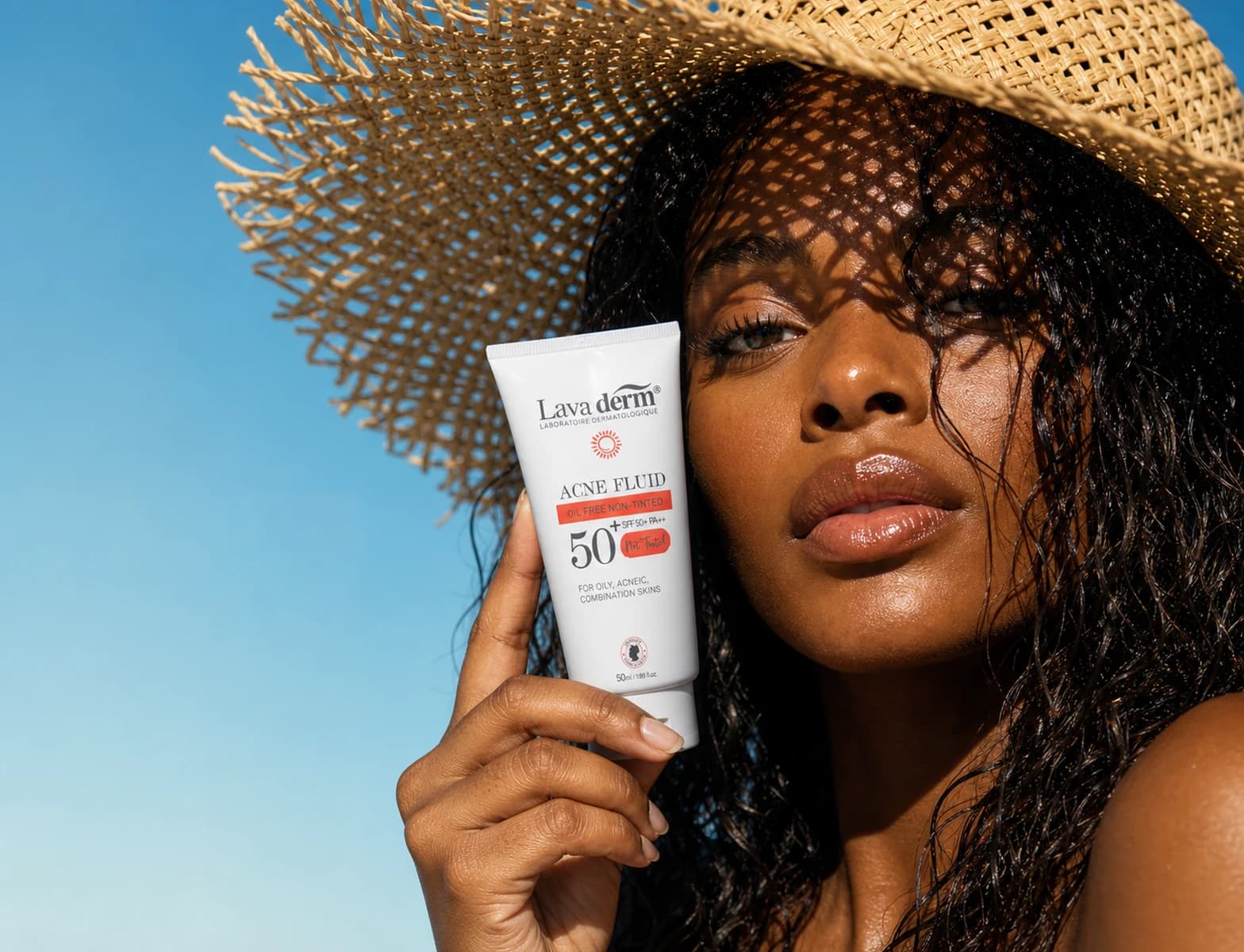
| Oily, combination or blemish-prone; prefer an untinted fluid | Lava Derm Acne Fluid SPF 50+ | Oil-free, untinted fluid; organic filters |
| Normal, combination or oily; prefer a matte cream | Lava Derm Sunblock Cream | Oil-free, extra-matte cream; mineral and organic filters together |
| Sensitive; prefer an untinted fluid | Lava Derm Physical Sunblock Fluid | Lightweight, untinted fluid; mineral and organic filters together |
| Dry or sensitive; prefer a moisturizing tinted cream | Lava Derm Physical Sunblock Cream | Soft-tint cream; mineral-only filters |
Four formulas, side by side
- UV filters on the pack
- Ethylhexyl methoxycinnamate (octinoxate); diethylamino hydroxybenzoyl hexyl benzoate; butyl methoxydibenzoylmethane (avobenzone).
- Applies to
- Face and neck
- Selected ingredients besides UV filters
- Zinc gluconate; lactoferrin and lactoperoxidase; panthenol; a vitamin C derivative.
- UV filters on the pack
- Chemical and mineral filters; names on the pack
- Applies to
- Face and neck
- Selected ingredients besides UV filters
- Zinc PCA; calendula and witch hazel; panthenol and glycerin.
- UV filters on the pack
- Nano titanium dioxide; butyl methoxydibenzoylmethane (avobenzone); ethylhexyl methoxycinnamate (octinoxate).
- Applies to
- Face and exposed body
- Selected ingredients besides UV filters
- Hydrolyzed hyaluronic acid; aloe vera; bisabolol, a soothing ingredient; dexpanthenol, a vitamin B5 ingredient.
- UV filters on the pack
- Titanium dioxide; zinc oxide.
- Applies to
- Face and neck
- Selected ingredients besides UV filters
- Sesame seed oil; licorice root extract; panthenol and glycerin.
Mineral vs chemical sunscreen for oily skin: which filters?
“Chemical” sunscreen usually means organic UV filters, a chemistry term unrelated to organic farming. Mineral filters include zinc oxide and titanium dioxide. Hybrid means a mix of mineral and organic filters.
For oily skin, the filter type does not decide the finish; texture and finish do, so use the table above.
Organic and mineral filters both protect from UV mainly by absorbing it. In a 2016 laboratory optics study (Cole and colleagues), zinc oxide and titanium dioxide reflected only about 4-5% of UV, which is too little to account for the protection. They reflect much more visible light, which is why a white cast can appear. That was not a test of a Lava Derm sunscreen.
The tinted cream’s UV filters are titanium dioxide and zinc oxide. “100% mineral filters” describes its UV filters, not the whole cream. Zinc gluconate in the oil-free fluid and zinc PCA in the matte cream are different from the UV filter zinc oxide.
Nano means very small particles of titanium dioxide. For a known filter allergy, check both fluids in the comparison above and the complete ingredients on their packs.
Tint, finish and sensitive skin
The oil-free cream dries matte. The fluids are patted in and left to set. The tinted cream gives light coverage and reduces white cast.
Check the shade across your whole face at a generous amount. A tiny swatch cannot show that. If the look makes you want to apply less, choose another finish.
With a known sesame allergy, have the tinted cream’s complete ingredients checked before trying it. Review ingredients beyond the filters too. “Sensitive skin” describes the intended skin group, not a guarantee against a reaction.
How much sunscreen, and how many uses per tube?
Cancer Council Australia gives an average-adult minimum: at least 1 teaspoon for each arm, each leg, the front and back of the torso, and for face, neck and ears together; about 7 teaspoons (35 mL) for a whole adult body. About 5 mL is that 35 mL split by 7, not a separately tested face dose.
AAD’s current guidance is different: at least 1 teaspoon for the face alone, with neck and ears extra. Use the body guide as a minimum for planning, not a measured dose for every face. Follow the product’s generous, even layer instruction; the area you cover changes how much you need.
This is a planning calculation, not a fixed tube lifetime: a larger covered area, more product or outdoor renewal uses the tube faster. Count applications rather than days when deciding what to carry.
A tube-size calculation, not a personal dose
- About 1 teaspoon, the adult-guide minimum per region
- 5 mL
- Every Lava Derm sunscreen tube
- 50 ml
- About this many applications at 5 mL each
- 10
Why amount and missed skin both matter
Choose a texture you can spread generously and evenly, then check for gaps. More product on an already covered patch cannot cover a missed one. Include exposed neck, ears and the edges of the face instead of judging coverage from the cheeks alone.
Missed skin after a first and second application
- After one application
- 20%
- After the second application
- 9%
Apply before makeup and plan renewal outdoors
Before first use on the face or a new area, try a small patch; this is a first-use check, not a diagnostic allergy test.
Use shade, protective clothing, a hat and sunglasses alongside sunscreen. Plan time for the steps below before your outing. Bring enough product for renewal; makeup comes after the sunscreen layer sets.
Prepare and apply an even layer
Prepare
Clean, dry face and neck.
Apply
Shake the fluid you are using gently. Spread a generous, even layer 15 minutes before sun exposure. Oil-free fluid and both creams: face and neck. Physical fluid: face and exposed body.
Blend
Pat lightly until blended.
Makeup
Allow the layer to set before makeup.
An outdoor renewal plan
- Every 2 hours
Renew the layer
Reapply every 2 hours. Physical fluid: at least every 2 hours outdoors.
- After swimming, sweating or towel-drying
Renew sooner
Reapply after swimming, sweating or towel-drying; the creams say immediately, the Physical fluid says after heavy sweating. Do not wait for the next timed application.
Common mistakes when choosing and wearing sunscreen
Four shortcuts to avoid.
- Treating SPF as a number of hours outdoors. It is a protection rating; do not extend your time in the sun because you are wearing sunscreen.
- Assuming a sunscreen is suitable for swimming because its name says “Physical”. Look for an explicit water-resistance claim on the current pack, rather than choosing by the filter category.
- Expecting the tinted cream to replace makeup or suit every complexion. Judge the cosmetic shade on your own skin.
- Expecting a sunscreen to treat acne. A blemish-prone skin label describes its intended users; persistent inflamed or painful breakouts need professional advice.
When to ask a pharmacist or doctor
For repeated burning, itching, swelling or rash, stop the product and take its pack to a pharmacist or doctor. Note the affected areas and other products used.
Ask about medicines that increase sun sensitivity, or diagnosed eczema, rosacea or photosensitivity. In pregnancy or breastfeeding, request a complete-formula review. Bring the pack.
A simple sunscreen routine
Cleanse, then apply the fluid last.
- 01
Cleanse
Massage the soap-free cleanser gently over damp face and neck, rinse thoroughly and pat dry.
Lava Derm Dermo Wash - 02
Protect
Use every morning, including cloudy days. Follow the fluid’s application and renewal directions above.
Lava Derm Acne Fluid SPF 50+
Questions, answered clearly
Does oil-free sunscreen mean a matte finish?
No. Oil-free describes the formula; matte describes appearance. For shine at work, look for an explicit matte-finish claim.
Which Lava Derm sunscreen works under makeup?
All four are the last skincare step before makeup: pat lightly, then let the film set before you apply makeup. The oil-free fluid layers well under makeup once patted in, and the matte cream dries matte.
Is the two-finger rule enough for my face and neck?
It is a fair minimum for the face alone. AAD describes at least 1 teaspoon for the face as about the length of your index and middle fingers, with neck and ears needing extra. How long the line is depends on the nozzle and how hard you squeeze, so treat it as a minimum, not a measured dose.
Does a tinted sunscreen always contain iron oxides?
No. A tint alone does not tell you which pigments are used. Lava Derm Physical Sunblock Cream lists titanium dioxide and zinc oxide as its filters and has a soft cosmetic tint. If iron oxides matter to you, read the ingredient list on the pack.
Do I still reapply mineral sunscreen under makeup?
Yes. The directions for the mineral cream still apply under makeup: reapply every 2 hours, and immediately after swimming, sweating or towel-drying.
Why might a sensitive-skin sunscreen sting?
A reaction can come from a filter or from another ingredient such as fragrance or a preservative, and a sensitive-skin label does not tell you which ones your skin tolerates. If it burns or itches again, stop using it and show the pack to a pharmacist or doctor.